9.30.2014

Success program for online students #edu14

Online DFW rates are still struggling when compared to F2F. Hybrid classes seem better than both (and in less time).

QM review useless without follow up with faculty to make sure changes are implemented. Why would faculty choose to not update their courses?

Q: how compliant is our syllabus template?

Success efforts
-self assessment for students
-template for course work and timeline
-syllabus quiz
-study tips for this course
-struggling student emails (we could create these as macros)
-scaffolding assignments (let students know where more efforts will be needed)

8.05.2014

Notes and Thoughts on Joy, Inc. by Richard Sheridan

Joy, Inc.: How We Built a Workplace People Love by Richard Sheridan.

There are some BIG take-aways that I am admittedly already primed to appreciate in this story: The premise of questioning the usual corporate/institutional mentality and methodology; the freedom to experiment; the failing fast and learning from those mistakes; the visual representations of work done and to be completed; and the learning learning learning more approach to employee development are all highly aligned with my own thoughts. It is inspiring to learn about a company that has found ways to make these the norm, but none of these conflict with any of my mental models of what can/should work in business and in education.

  • Let's question seat time, lectures, grades, multiple choice assessments as the only models for learning. (many are and you inspire me!)
  • Let's encourage error making and allow students to fail without damaging repercussions on their future goals.
  • Let's provide an easy to understand visual indicator of a students achievements, skills and competencies.
  • Let's continue to provide inspiring challenges for learners to accomplish something meaningful.


And there were other elements of the story that DID challenge my concepts of a truly joyful workplace (for me): Paired work is a huge one (Sharing one computer! Yikes! I'm a total mouse hog); open floor plans -- won't the noise bother me?; Funny hat-wearing public team-share round robin reporting -- I appreciate the need for a relaxed environment, but the description here seems awkward/embarrassing, no?

Sheridan is careful to tell us that not all of these specific habits are necessary components of a joyful workplace. But the sharing of the joy is important...
A joyful culture produces stories the world is yearning to hear. Capturing those stories and retelling them often reinforces your culture, as the outside world will want to come peek inside, ask probing questions, and walk away inspired to pursue their own joyful journey.
A joyful culture draws in people from outside the company, including clients, the local community, and the press.

Sharing naturally happens more (more easily) in open environment where people work together. My concerns with paired work were somewhat tempered here...
...when asked, the majority of our team self-identify as introverts. This makes sense to me for several reasons: Introversion supports the deep thinking needed to solve complex problems. Introverts prefer fewer, deeper relationships. Introverts are often better, active listeners.
If everyone is tired and stressed, and also allowed to close his or her door or block out the world with earbuds, the chances of overhearing others' ideas just won't occur. 

This doesn't address the noise issue, but it does cause me to reflect on the paired activities and paired practice classes I designed for my Chinese class last year. Each pair would decide on what they needed to practice most and then work on it together -- they could read passages, practice vocab, challenge each other with questions they would be asked to respond to later during interviews -- the idea was to keep producing verbally, so it shouldn't have been a quiet environment. It worked some days, but other days, when lack of preparedness, stress, fatigue got them down, they reverted back to their old comfortable isolated quiet individual ways.
If change is to stick, you must quickly replace the old rewards with new rewards of equal or greater value (and remember, most treasured rewards are not monetary). Failure to establish new rewards will cause the team to revert to old forms and old rewards the first chance they get.
Not sure I adequately provided new rewards.

Other positive elements of paired working include faster and easier hiring of new employees, scalability, and simply sharing the load. I know from the MOOC we offer to new online instructors, the team (pair) teaching that happens there, improves the course greatly (thanks Emily) (and quite frankly, I couldn't do it by myself, nor would I want to). I had a few team taught courses in college, and they were always really interesting as the instructors would invariably get into a discussion that would extend beyond the course and often demonstrated how intelligent, knowledgable people could engage in intellectual disagreement. At the very least/most, different points of view were presented, and we all need to witness different viewpoints more often.

Lots more to think about. However, in the interest of getting this post done (another part of a joyful workplace), I'll stop here. Read it, and talk about it.

(Thanks Nicole for recommending this title!)

5.21.2014

Notes and Reflections on "A New Culture of Learning"

A New Culture of Learning by Douglas Thomas and John Seely Brown

Thanks Library (and Kate in IC) for acquiring this book. It is packed with intriguing ideas.

Culture as growth because of environment

We are, our systems are still operating in a Mechanistic model of teaching. It's a model based in efficiencies. I like efficiency and the easy measurable nature of outcomes. Yet I am often disappointed with predictable results - some pass, some fail, some get Cs. In the Learning Environment model, the space opens up to more potential for wow from everyone.
Mechanistic - "Learning is treated as a series of steps to be mastered..."
Learning Environments - "...where the context in which learning happens, the boundaries that define it, and the students, teachers, and information within it all coexist and shape each other in a mutually reinforcing way."
Reminds me of the distinction between training and learning, but it goes deeper than just this simple dichotomy. Cultures equipped with the digital networked infrastructure are more susceptible to influence and change. They welcome newness and wish well those who move along to other cultures. I wonder if we are increasingly defining ourselves by ever smaller culture groups? Is it meaningful to know I am a white American who lived in China? Is it more meaningful to know that I am a gardener and Wordpress enthusiast (I know I am posting on Blogger - I like Blogger too)?

Community and Collective.
"In communities, people learn in order to belong. In a collective, people belong in order to learn. Communities derive their strength from creating a sense of belonging, while collectives derive theirs from participation."
For a while now, the community building practices of online courses (aka the discussion forum) have fallen short of expectations. I find this collective-community distinction inspiring and worthy of thought. And it will take thought to discover just how such a distinction could play out in any given learning environment.

In many ways I have experienced the shortfall of community building in my courses. I've held aloft the community itself as the end goal, the product, the promise of learning well designed (Great discussions everyone!). But then what? The class ends. The community dissolves, and the participation in thought and exercise is laid bare to have only existed for the purposes of the system.

Tacit Knowledge
"They experiment with what they already know how to do and modify it to meet new challenges and contexts. In a world where things are constantly changing, focusing exclusively on the explicit dimension is no longer a viable model of education"
Software training can't just be about step 1, 2, 3 -- a mindset must be established within the user that encourages their own trial and error. What would the designer/programmer want me to do at this point? At the same time drill and practice is a necessary part of learning, the fundamentals must be accessible -- a desktop computer will not function if not plugged in. "Exclusively" is an important word in the above quote and also begs the question of appropriate proportions.

Another personal struggle I have and have witnessed is a tension between knowing why something has produced an error (specific cause) and how to fix or work-around the error. It's often a generational conflict.
"Here is the fix for your issue," I might say.
"What caused that issue?" they ask.
"Well, some incompatibility in your browser... but specifically, I'm not sure."
"Oh, that's not reassuring to hear from technical support."
I do feel an internal struggle to know ALL the reasons, but also understand that knowing in that sense, at that level of explicit knowledge of zeros and ones, is not going to help this person. They really just need the fix.

Play

There are elements of practice and learning that are tedious. Small wins carry us through these moments. Or the communities we play alongside pull us through. Playing with others means working toward a common goal. It means communicating. It means collaboration. It means trust. It means making mistakes and suggesting solutions. It means challenging ourselves to do better, to be better.

I know some who feel like play is synonymous with games, and some do not like games. That's ok. Think of this as playful then. Be playful with what you will learn. Manipulate/transform your learning into a goal you and others care about. Take pride in your accomplishments. Learn to enjoy learning.

10.15.2013

Altered Context

Implementing change in education must include changing teachers’ practices a beliefs. This does not mean abandoning beliefs but gradually replacing them with more relevant beliefs shaped by experiences in an altered context. And it is this altered context that may make the difference.
Teacher Beliefs and Practices Part I: Patterns of Change
http://www.apple.com/euro/pdfs/acotlibrary/rpt8.pdf

I had a discussion yesterday about the growing need for digital assessments in our interactive tv classrooms. The quote above seems relevant. The need has grown because the context of the mail system has changed. We can't change this context. The mail is now only touched once per day - which can translate to 3-5 days in transit - one way. That's the context. If the belief of assessing students includes timely feedback on the assessment, then how does this context shift the nature of this assessment?

1.27.2013

Reductionism - tools

Enrolled and beginning E-Learning and Digital Cultures MOOC on Coursera.

First reading: Chandler, D. (2002). Technological determinism. Web essay, Media and Communications Studies, University of Aberystwyth, http://www.aber.ac.uk/media/Documents/tecdet/tecdet.html

I'm excited to see language and vocabulary to help me better understand why I pause at the 'technology is a tool' mantra I often hear from educators presenting their views on using or not using technology with their students.
Technological determinists often seem to be trying to account for almost everything in terms of technology: a perspective which we may call technocentrism. To such writers we are first and foremost Homo faber - tool-makers and tool-users. The American Benjamin Franklin apparently first coined the phrase that 'man is a tool-using animal'. Thomas Carlyle echoed this in 1841, adding that 'without tools he is nothing; with them he is all.'

And earlier in the essay...
As the social critic Lewis Mumford has noted, one reductionist tendency is the identification of technology with tools and machines. This is merely, as he put it, 'to substitute a part for the whole' (in Pursell 1994, p. 26), because technology includes the whole of our material culture, not only tools and machines. It is also worth noting (as Carroll Pursell observes), that this reductionist interpretation involves a masculinization of technology. Just as the penis is sometimes referred to as a tool, so tools can be seen as symbolically phallic. Such symbolism has generated profound cultural reverberations.

Reducing the role technology has in our lives and schools to tools, or more generally objects, oversimplifies the position and interdependence humans and technology share. And making technology masculine is just plain messed up interesting. I asked Siri. She totally agrees.

11.09.2012

Illusion of Transparency

Possible activity for first-time online students inspired by PsyBlog's post on the Illusion of Transparency.

First have student try to tap our a rhythmic melody to a commonly known tune as he suggests. Let's see how many figure it out. Then have them craft a sentence or two asking an instructor a clarifying question of some kind. What's missing from the communication? Are there any areas to be improved? Any areas that might give rise to concern?

7.21.2012

Nutty Research

How Academics Face the World: A Study of 5829 Homepage Pictures
http://wwffm.org/2012/07/21/how-academics-face-the-world-a-study-of-5829-homepage-pictures/

I like seeing off the wall research topics like this one. Makes me feel good about any idea I might ever have. I couldn't bring myself to read the entire paper, but the gist is that photos of academics on their faculty websites show either the left or right cheek and this correlates to their discipline. The authors explain that the left cheek forward shows more emotion so science faculty are not as inclined to display that side. The idea here is that science faculty are lacking emotive qualities and humanities faculty are more sensitive. This alone is comical stereotyping, but stereotypes exist for a reason I suppose.

What I am still wondering about though are all the other confounding factors. What about handed-ness? Were all the subjects right handed? And what about the photographer who took these pictures? Perhaps it is his/her tendency that is being observed here. Or maybe the web designer chose these images from a group and it is her bias we see. Maybe it matters which side of the page the image is on.

Or maybe they are right after all. My image on my faculty page shows an old avatar from Second Life. I guess I should update that - I think I will take my image with left cheek forward, but then flip it horizontally in Photoshop.


7.14.2012

BbWorld Reflection - conversation at Mobile Learn booth #bbw12

After the keynote from Michael and Ray, I wanted to talk to the Mobile crew about the updates and how/when these might make their way into the Angel mobile interface. So, here is how that went down.

Me: So, I'm excited to see the Push and Testing features coming to the mobile learn app. Can you tell me if these updates will be available in the Angel version?

Mobile Guy: Oh, well, I'm actually in marketing so I don't know really. I know they are working on the Angel mobile piece.

Me: Um, okay...

Mobile Guy: I can give you a t-shirt though.

Me: That'll work.

Mobile Guy: Here you go. Thanks for stopping by.


7.13.2012

BbWorld Reflection - Teacher Training #bbw12

I attended several sessions on teacher training. One of which was a free for all type sharing of success stories. Plenty to be shared, but little data to back up the ideas (or maybe stories are just easier to share than data). This lack of data compelled me to attend the session titled Teacher Training-Worth the Effort Practices. There was data here, but not entirely transferable to Kirkwood. Still, all sessions were interesting and generated ideas.


WE NEED MORE DATA! Institutions are largely doing the same kinds of workshops and no one seem to know which efforts are really paying off. As an example, one participant suggested that we need to rebrand teacher training since professors do not respond to this word "training." Training is what kids do at McDonalds, she explained. She could be right, but I'd like to see the data that shows increased attendance and/or improved results from sessions renamed "workshops" or "PD."


PROFESSIONAL DEVELOPMENT FOR ALL! Professional development efforts are a strange beast, not just at Kirkwood, but I think this is a part of the larger culture. The approach assumes teachers are inherently good learners. And some are, perhaps most are (Anyone know the average GPA of their faculty?), but usually even the good learners' skills are very focused in particular areas. And these areas naturally drive their interest in PD - informing and misinforming their PD decisions. I am no different. I want to learn more about what I am interested in and not so much about what I need to do my job better. Most of the time we are not aware of our needs, but are acutely aware of interests.


DELIVERED ON THEIR TERMS - delivery often happens in a way that produces dependency, rather than inquiry. Is attending PD sessions just part of the job? I don't see this job mentality too much, but it's there, and it's especially present when LMS training is apart from what is interesting/useful. Many schools shared success stories of embedding their training into department visits which, I'm guessing, would allow for some of this focus (of course, it would also limit the amount of cross-pollination of ideas that I personally believe in - without data of course.)


Bb World - Big Announcements #bbw12

The big announcements from Bb World 2012:


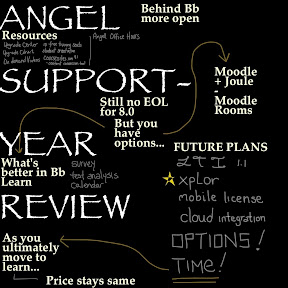
xpLor - a free external repository for standard compliant content, tagged and shared between ALL LMS products. Angel has it's LOR, but this is akin to a global LOR. Very interesting--a great way to promote sharing and more open educational resources. Other "xp" products to come (forums, calendar).

Mobile Learn license structure - cost to be passed to the student. Institutions can choose to partner/subsidize the app cost. A huge improvement from the tight bonds of a Sprint agreement.

Mobile improvements - (not necessarily for Angel version yet) Push notifications & Assessments! The assessment part I find funny, because I can't tell you how many Bb sales guys balked at my amazement tests were not in the app. They would explain it away in a condescending, mocking tone saying, "there are always a few fringe people who want to do everything on mobile, but most don't want testing." So, to all those sales guys, I hate to say it, but I told you so.

Publisher agreements - this is an interesting space, but as Angel users we don't seem to have it as easy. And that's really on the publishers to figure out or ignore. McGraw Hill have made some attempts - still not functioning at our college, but the thought counts.

I'll be processing some of the session information and post on that in the days to follow. Check my twitter feed (@fredandcharlie) to see some of the session notes I shared. BbWorld 2012 might be closed, but our minds are still open.

7.11.2012

A Somber Party #bbw12

The Angel team presented in their slightly apologetic tone on the present state of the platform and Bb's well articulated position. It's not unlike visiting a hospital and hearing your options from the physicians. There is a palpable sadness. Choices must be made. Not right away, but eventually... And In the meantime, here is what we can do to treat your symptoms.


And later in the afternoon, we gathered once more to toast the platform that brought us together. A platform many had a voice in shaping. To toast the people that will inevitably continue to shape the land of eLearning--still an incredibly vibrant place to be.

7.10.2012

Overwhelmed - #bbw12

New Orleans is itself overwhelming. I only managed to arrive in time to checkin and run to the welcome reception and tour the show floor. From the food to the beverages to the size of the displays to the theater productions. I'm overwhelmed. I admit it doesn't take much, but this is really a big production.


A couple of thoughts on the way in... I was impressed by the shuttle driver's welcome speech. He was going through his standard speech, but it was spoken with such confidence, such conviction. And he ended it with a question like, "Sound good to everyone?" And when no one responded, he repeated the question so as to connect with the passengers. Connections, need to make connections.

Selecting Sessions - #bbw12

I struggle with the selection of conference sessions. It shouldn't be so difficult, but the sessions and inspiration or knowledge drawn from these morsels of research and experience make or break a conference. The problem I encounter, as I flip through the myriad of potential themes, is that I am inevitably drawn to sessions on topics I am interested in. Which means I know something about them. I have and share some experiences (likely) with the presenters. Which means, there is a higher probability that the session will be a reinforcement of ideas I already have. And there is a potential, albeit a slim one, that I have more experience and research on the topic than the presenter. So these sessions are a gamble.
On the complete other side of the spectrum are sessions on topics I know nothing about -- there is a whole theme dedicated to Bb Analytics engine -- and while we are proud Angel users, the concept of mining the LMS for data and early intervention intrigues me. But then this is a product we do not have at Kirkwood, so it might also be a gamble.
And then there are sessions that are geared toward IT professionals, which I am not (surprise!), and others geared toward administrators just beginning their journey into online programs and courses. I can skip these I think (sorry presenters).
The sessions I have chosen seem to fall into a couple of categories: support, training, engagement, mobile, and feedback. If you are presenting in one of these topics, I'm looking forward to it. Need to head to the airport in about 30 minutes. Safe travels!

6.05.2012

Technology Whiners

I spend a fair amount of time looking at software, thinking about applications, clicking on buttons, stumbling through menus, guessing what the designers had in mind, making errors, learning from those mistakes, and otherwise using technology. Maybe a little more than some, but certainly less than others. I'm no uber-geek, but I probably qualify as a regular geek. I like (and know the difference between) Star Wars and Star Trek, but I would not likely wear a costume or buy a phaser.

I also spend a good amount of time helping others cope with technology, and so I am privileged to assist those in need. On the other hand, I also enjoy the company of inaccurate blamers ("I know I loaded an .exe file last year and it worked fine."), superstitious shoulder-shruggers ("You have the magic touch." or "This software just does not like me.") and general technology whiners ("It just doesn't work for me."). And I really do enjoy them (most of the time) -- people are fascinating bundles of experiences and interpretations of these experiences.

Another time-intensive endeavor for me is jumping around the Internet, opening new tabs when articles catch my interest. Eventually, I become overwhelmed at the number of open tabs and feel the need to review and close some. In the process of closing a few this morning, these two wound up next to each other:

Whine, Whine, Whine: Four Simple Steps for Dealing with Complainers. Psychology Today. June 3, 2012.
32 Innovations That Will Change Your Tomorrow. The New York Times Magazine. June 1, 2012.

Some random thoughts follow:

  • Naturally, there will be no shortage of tech to complain about in the future
  • Complainers do not necessarily want solutions
  • Time-limited compassion is not necessarily an oxymoron
  • #30/32 Would give rise to complaints from my tomatoes and peppers

5.01.2012

Language and Psychology Meet

One more reason to study a second language. You might make better decisions, or at least be less susceptible to decision bias. Although this might also give one more reason to not learn that second language too well - as I would expect the biases might return with more proficiency and experiences. Just a hunch.

The Foreign-Language EffectThinking in a Foreign Tongue Reduces Decision Biases

4.29.2012

Google Forms Doodle

I attended a conference earlier this month and was recently flipping through some of the handouts. I attended one session that covered useful tools for educators that included Google forms and other applications. I was a little bored and started doodling.
Form Element Guys
(click for a larger image)

I was having fun making these little characters out of the various web form elements. I could imagine a whole animated series with these guys. Need to explore more characters. Submit Button Nose? And some personality traits could correspond to their physical natures. TextArea Cyclops would always have a lot to say. And Radio Eyes might be extremely stubborn - only accepting one answer or point of view. I can't wait for the first episode in which Checkbox Eyes and Dropdown Mouth collaborate on what ingredients to add to a large pot of soup. 

4.26.2012

New Grading Scheme (for me)

I'm teaching a blended adult accelerated (5 week) course. Just started last monday - which was the last time we meet as a class face-to-face. The rest of the course will be completed online. Angel is our LMS of choice at the College and so that's our launch pad and organizing utility. That much was obvious. What was not obvious was how to re-organize and re-structure my activities for the online portion of the course. Which is a little funny since it's kind of my job to help other instructors re-discover their own materials in the light of an online delivery format.

I typically stress the importance of thinking in terms of activities - final projects and working backwards to include the building blocks that will help students achieve these goals (I know the word is scaffolding, but I'm weary of this term as it applies to education). So I did that. No problems there really... I'm sure I could probably provide more blocks for some... but they can ask for them.

Where I then struggled was a point system. I had all these activities leading to various goals and no point scheme. And then a late policy needed to be crafted that would encourage completion of these activities. I thought about dividing the 15 or so assignments into 100 points so that the more difficult assignments were 10-20 points while the easier assignments were less. And then the usual late policy of 10% deduction per day - up to 3 days or something like that. Boring. I've done that before. Late work is still all too normal and I want to encourage early work - especially on discussions.

As this only just started, I have no idea how it may play out and I have no control group, so this won't be a true study. But here is what I came up with. I'm starting everyone out at 100%. For each assignment, there are chances to gain bonus points as well as incur losses. Points are lost if directions are not followed or performance does not meet expectations of the assignment. Points are gained for early submissions (particularly on discussion forums) and for going beyond the expectations of the assignment. As for late policy, a -2 point deduction occurs on any late submissions and submissions can be up to 24 hours late. Beyond that, the assignment is not accepted and a -10 point deduction is recorded. That might seem harsh, but there are plenty of opportunities to gain bonus points for other assignments.

So far, and it's still early, I do not see much early posting going on in the discussions. Perhaps my bonus is not high enough. Perhaps these students (who all have other jobs), have other higher priorities than this class. But the submissions received have been great. And over half of the students chose to answer a bonus question on a reflection writing assignment. It's interesting at this point.

The gradebook is a bit of a challenge. I created an assignment and gave everyone 100 points/percent. Then I created individual extra credit assignments to hold the point loss/gain for each assignment. Angel seems to support negative points just fine, so this is working quite well. When I look at the gradebook, I can only see net performance on individual assignments, so I am thinking I will need to keep track of losses and gains in another spreadsheet. I sound like an accountant. Yikes. I could have split it out and done a column for loss and gain per assignment, but that seemed ugly. I do wish there was a way to show labels to students instead of points, so I could show something other than zero when they break even or meet the expectations.

So there is the new scheme. I'll post again mid-way through on any thoughts and then again at the end with some stats on early vs late vs non-submissions as well as how many bonuses were achieved through additional time and energy with the material and experiences.

4.21.2012

Why I want to be a VIP BbWorld Blogger


Sharing - that's my platform. As bloggers, we share our thoughts and reflections and sometimes opinions with the world as it flies past on its high-speed Internet connection. As an Iowan, I know what it means to be flown over. Visits are rare, so when they happen, take advantage! Share experiences and knowledge and make connections with people.

At BbWorld, users, developers, administrators, vendors and executives gather to share an experience and make these connections. I want to capture these intersections of passion + excitement + ingenuity + intelligence and share them with a larger audience.

I like to blog in ways that entertain and inform. I'm an aspiring visual note taker and often post these doodles on this blog. Doodles like this one:

Doodle from Distance Learning Conference. Madison, WI
(Click the image for a larger view)

As an Angel administrator and trainer for Kirkwood Community College, I publish the KirkwoodLMS blog. As an instructional designer for Distance Learning, I join Emily McWorthy in creating our video blog: Technology for Learners and Teachers. And as a teacher, I speak with Nicole Forsythe in a new audio podcast/blog on EducationIS.us. I'm a blogger.

See you in New Orleans!

4.20.2012

zefrank on tech and humanity

ZeFrank is publishing new episodes of A Show! Makes the world a better place. In this episode, he shows how technology assists in making him and his videos more humanistic. I just shared this with my Culture and Technology course.

4.19.2012

SquadMail

This could be a promising little app for committee work, support staff, ... https://www.squadmail.com?u=3a625e6.