1.27.2013

Reductionism - tools

Enrolled and beginning E-Learning and Digital Cultures MOOC on Coursera.

First reading: Chandler, D. (2002). Technological determinism. Web essay, Media and Communications Studies, University of Aberystwyth, http://www.aber.ac.uk/media/Documents/tecdet/tecdet.html

I'm excited to see language and vocabulary to help me better understand why I pause at the 'technology is a tool' mantra I often hear from educators presenting their views on using or not using technology with their students.
Technological determinists often seem to be trying to account for almost everything in terms of technology: a perspective which we may call technocentrism. To such writers we are first and foremost Homo faber - tool-makers and tool-users. The American Benjamin Franklin apparently first coined the phrase that 'man is a tool-using animal'. Thomas Carlyle echoed this in 1841, adding that 'without tools he is nothing; with them he is all.'

And earlier in the essay...
As the social critic Lewis Mumford has noted, one reductionist tendency is the identification of technology with tools and machines. This is merely, as he put it, 'to substitute a part for the whole' (in Pursell 1994, p. 26), because technology includes the whole of our material culture, not only tools and machines. It is also worth noting (as Carroll Pursell observes), that this reductionist interpretation involves a masculinization of technology. Just as the penis is sometimes referred to as a tool, so tools can be seen as symbolically phallic. Such symbolism has generated profound cultural reverberations.

Reducing the role technology has in our lives and schools to tools, or more generally objects, oversimplifies the position and interdependence humans and technology share. And making technology masculine is just plain messed up interesting. I asked Siri. She totally agrees.

11.09.2012

Illusion of Transparency

Possible activity for first-time online students inspired by PsyBlog's post on the Illusion of Transparency.

First have student try to tap our a rhythmic melody to a commonly known tune as he suggests. Let's see how many figure it out. Then have them craft a sentence or two asking an instructor a clarifying question of some kind. What's missing from the communication? Are there any areas to be improved? Any areas that might give rise to concern?

7.21.2012

Nutty Research

How Academics Face the World: A Study of 5829 Homepage Pictures
http://wwffm.org/2012/07/21/how-academics-face-the-world-a-study-of-5829-homepage-pictures/

I like seeing off the wall research topics like this one. Makes me feel good about any idea I might ever have. I couldn't bring myself to read the entire paper, but the gist is that photos of academics on their faculty websites show either the left or right cheek and this correlates to their discipline. The authors explain that the left cheek forward shows more emotion so science faculty are not as inclined to display that side. The idea here is that science faculty are lacking emotive qualities and humanities faculty are more sensitive. This alone is comical stereotyping, but stereotypes exist for a reason I suppose.

What I am still wondering about though are all the other confounding factors. What about handed-ness? Were all the subjects right handed? And what about the photographer who took these pictures? Perhaps it is his/her tendency that is being observed here. Or maybe the web designer chose these images from a group and it is her bias we see. Maybe it matters which side of the page the image is on.

Or maybe they are right after all. My image on my faculty page shows an old avatar from Second Life. I guess I should update that - I think I will take my image with left cheek forward, but then flip it horizontally in Photoshop.


7.14.2012

BbWorld Reflection - conversation at Mobile Learn booth #bbw12

After the keynote from Michael and Ray, I wanted to talk to the Mobile crew about the updates and how/when these might make their way into the Angel mobile interface. So, here is how that went down.

Me: So, I'm excited to see the Push and Testing features coming to the mobile learn app. Can you tell me if these updates will be available in the Angel version?

Mobile Guy: Oh, well, I'm actually in marketing so I don't know really. I know they are working on the Angel mobile piece.

Me: Um, okay...

Mobile Guy: I can give you a t-shirt though.

Me: That'll work.

Mobile Guy: Here you go. Thanks for stopping by.


7.13.2012

BbWorld Reflection - Teacher Training #bbw12

I attended several sessions on teacher training. One of which was a free for all type sharing of success stories. Plenty to be shared, but little data to back up the ideas (or maybe stories are just easier to share than data). This lack of data compelled me to attend the session titled Teacher Training-Worth the Effort Practices. There was data here, but not entirely transferable to Kirkwood. Still, all sessions were interesting and generated ideas.


WE NEED MORE DATA! Institutions are largely doing the same kinds of workshops and no one seem to know which efforts are really paying off. As an example, one participant suggested that we need to rebrand teacher training since professors do not respond to this word "training." Training is what kids do at McDonalds, she explained. She could be right, but I'd like to see the data that shows increased attendance and/or improved results from sessions renamed "workshops" or "PD."


PROFESSIONAL DEVELOPMENT FOR ALL! Professional development efforts are a strange beast, not just at Kirkwood, but I think this is a part of the larger culture. The approach assumes teachers are inherently good learners. And some are, perhaps most are (Anyone know the average GPA of their faculty?), but usually even the good learners' skills are very focused in particular areas. And these areas naturally drive their interest in PD - informing and misinforming their PD decisions. I am no different. I want to learn more about what I am interested in and not so much about what I need to do my job better. Most of the time we are not aware of our needs, but are acutely aware of interests.


DELIVERED ON THEIR TERMS - delivery often happens in a way that produces dependency, rather than inquiry. Is attending PD sessions just part of the job? I don't see this job mentality too much, but it's there, and it's especially present when LMS training is apart from what is interesting/useful. Many schools shared success stories of embedding their training into department visits which, I'm guessing, would allow for some of this focus (of course, it would also limit the amount of cross-pollination of ideas that I personally believe in - without data of course.)


Bb World - Big Announcements #bbw12

The big announcements from Bb World 2012:


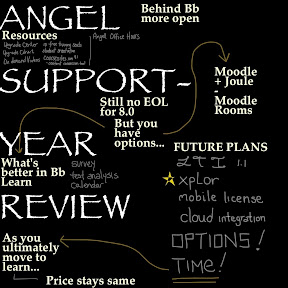
xpLor - a free external repository for standard compliant content, tagged and shared between ALL LMS products. Angel has it's LOR, but this is akin to a global LOR. Very interesting--a great way to promote sharing and more open educational resources. Other "xp" products to come (forums, calendar).

Mobile Learn license structure - cost to be passed to the student. Institutions can choose to partner/subsidize the app cost. A huge improvement from the tight bonds of a Sprint agreement.

Mobile improvements - (not necessarily for Angel version yet) Push notifications & Assessments! The assessment part I find funny, because I can't tell you how many Bb sales guys balked at my amazement tests were not in the app. They would explain it away in a condescending, mocking tone saying, "there are always a few fringe people who want to do everything on mobile, but most don't want testing." So, to all those sales guys, I hate to say it, but I told you so.

Publisher agreements - this is an interesting space, but as Angel users we don't seem to have it as easy. And that's really on the publishers to figure out or ignore. McGraw Hill have made some attempts - still not functioning at our college, but the thought counts.

I'll be processing some of the session information and post on that in the days to follow. Check my twitter feed (@fredandcharlie) to see some of the session notes I shared. BbWorld 2012 might be closed, but our minds are still open.

7.11.2012

A Somber Party #bbw12

The Angel team presented in their slightly apologetic tone on the present state of the platform and Bb's well articulated position. It's not unlike visiting a hospital and hearing your options from the physicians. There is a palpable sadness. Choices must be made. Not right away, but eventually... And In the meantime, here is what we can do to treat your symptoms.


And later in the afternoon, we gathered once more to toast the platform that brought us together. A platform many had a voice in shaping. To toast the people that will inevitably continue to shape the land of eLearning--still an incredibly vibrant place to be.

7.10.2012

Overwhelmed - #bbw12

New Orleans is itself overwhelming. I only managed to arrive in time to checkin and run to the welcome reception and tour the show floor. From the food to the beverages to the size of the displays to the theater productions. I'm overwhelmed. I admit it doesn't take much, but this is really a big production.


A couple of thoughts on the way in... I was impressed by the shuttle driver's welcome speech. He was going through his standard speech, but it was spoken with such confidence, such conviction. And he ended it with a question like, "Sound good to everyone?" And when no one responded, he repeated the question so as to connect with the passengers. Connections, need to make connections.

Selecting Sessions - #bbw12

I struggle with the selection of conference sessions. It shouldn't be so difficult, but the sessions and inspiration or knowledge drawn from these morsels of research and experience make or break a conference. The problem I encounter, as I flip through the myriad of potential themes, is that I am inevitably drawn to sessions on topics I am interested in. Which means I know something about them. I have and share some experiences (likely) with the presenters. Which means, there is a higher probability that the session will be a reinforcement of ideas I already have. And there is a potential, albeit a slim one, that I have more experience and research on the topic than the presenter. So these sessions are a gamble.
On the complete other side of the spectrum are sessions on topics I know nothing about -- there is a whole theme dedicated to Bb Analytics engine -- and while we are proud Angel users, the concept of mining the LMS for data and early intervention intrigues me. But then this is a product we do not have at Kirkwood, so it might also be a gamble.
And then there are sessions that are geared toward IT professionals, which I am not (surprise!), and others geared toward administrators just beginning their journey into online programs and courses. I can skip these I think (sorry presenters).
The sessions I have chosen seem to fall into a couple of categories: support, training, engagement, mobile, and feedback. If you are presenting in one of these topics, I'm looking forward to it. Need to head to the airport in about 30 minutes. Safe travels!

6.05.2012

Technology Whiners

I spend a fair amount of time looking at software, thinking about applications, clicking on buttons, stumbling through menus, guessing what the designers had in mind, making errors, learning from those mistakes, and otherwise using technology. Maybe a little more than some, but certainly less than others. I'm no uber-geek, but I probably qualify as a regular geek. I like (and know the difference between) Star Wars and Star Trek, but I would not likely wear a costume or buy a phaser.

I also spend a good amount of time helping others cope with technology, and so I am privileged to assist those in need. On the other hand, I also enjoy the company of inaccurate blamers ("I know I loaded an .exe file last year and it worked fine."), superstitious shoulder-shruggers ("You have the magic touch." or "This software just does not like me.") and general technology whiners ("It just doesn't work for me."). And I really do enjoy them (most of the time) -- people are fascinating bundles of experiences and interpretations of these experiences.

Another time-intensive endeavor for me is jumping around the Internet, opening new tabs when articles catch my interest. Eventually, I become overwhelmed at the number of open tabs and feel the need to review and close some. In the process of closing a few this morning, these two wound up next to each other:

Whine, Whine, Whine: Four Simple Steps for Dealing with Complainers. Psychology Today. June 3, 2012.
32 Innovations That Will Change Your Tomorrow. The New York Times Magazine. June 1, 2012.

Some random thoughts follow:

  • Naturally, there will be no shortage of tech to complain about in the future
  • Complainers do not necessarily want solutions
  • Time-limited compassion is not necessarily an oxymoron
  • #30/32 Would give rise to complaints from my tomatoes and peppers